
Dengue Info
Dengue Fever |
Top |
Dengue fever is a mosquito-borne tropical disease caused by the dengue virus. Symptoms typically begin three to fourteen days after infection. This mayinclude a high fever, headache, vomiting, muscle and joint pains, and a characteristic skin rash. Recovery generally takes two to seven days. In a small proportion of cases, the disease develops into the life-threatening dengue hemorrhagic fever, resulting in bleeding, low level of blood platelets and blood plasma leakage, or into dengue shock syndrome, where dangerously low blood pressure occurs. Dengue is spread by several species mosquito of the Aedes type, principally A. aegypti. The virus has five different types; infection with one type usually gives lifelong immunity to that type, but only short-term immunity to the others. Subsequent infection with a different type increases the risk of severe complications. A number of tests are available to confirm the diagnosis including detecting antibodies to the virus or its RNA.
A novel vaccine for dengue fever has been approved and is commercially available in a number of countries. Other methods of prevention are by reducing mosquito habitat and limiting exposure to bites. This may be done by getting rid of or covering standing water and wearing clothing that covers much of the body. Treatment of acute dengue is supportive and includes giving fluid either by mouth or intravenously for mild or moderate disease. For more severe cases blood transfusion may be required. About half a million people require admission to hospital a year. Nonsteroidal anti-inflammatory drugs (NSAIDs) such as ibuprofen should not be used. Dengue has become a global problem since the Second World War and is common in more than 110 countries. Each year between 50 and 528 million people are infected and approximately 10,000 to 20,000 die. The earliest descriptions of an outbreak date from 1779. Its viral cause and spread were understood by the early 20th century. Apart from eliminating the mosquitoes, work is ongoing for medication targeted directly at the virus. It is classified as a neglected tropical disease.
Signs and Symptoms |
Top |
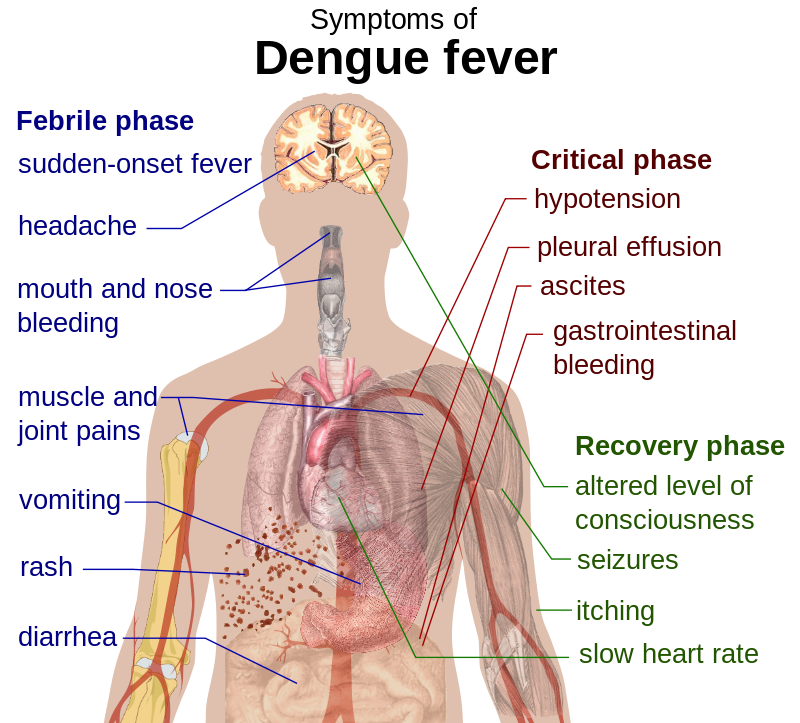 Typically, people infected with dengue virus are asymptomatic (80%) or have only mild symptoms such as an uncomplicated fever. Others have more severe illness (5%), and in a small proportion it is life-threatening. The incubation period (time between exposure and onset of symptoms) ranges from 3 to 14 days, but most often it is 4 to 7 days. Therefore, travelers returning from endemic areas are unlikely to have dengue if fever or other symptoms start more than 14 days after arriving home. Children often experience symptoms similar to those of the common cold and gastroenteritis (vomiting and diarrhea) and have a greater risk of severe complications, though initial symptoms are generally mild but include high fever.
The characteristic symptoms of dengue are sudden-onset fever, headache (typically located behind the eyes), muscle and joint pains, and a rash. The alternative name for dengue, "breakbone fever", comes from the associated muscle and joint pains. The course of infection is divided into three phases: febrile, critical, and recovery.
The febrile phase involves high fever, potentially over 40 °C (104 °F), and is associated with generalized pain and a headache; this usually lasts two to seven days. Nausea and vomiting may also occur. A rash occurs in 50–80% of those with symptoms in the first or second day of symptoms as flushed skin, or later in the course of illness (days 4–7), as a measles-like rash.
A rash described as "islands of white in a sea of red" has also been observed. Some petechiae (small red spots that do not disappear when the skin is pressed, which are caused by broken capillaries) can appear at this point, as may some mild bleeding from the mucous membranes of the mouth and nose. The fever itself is classically biphasic or saddleback in nature, breaking and then returning for one or two days.
The rash of dengue fever in the acute stage of the infection blanches when pressed. In some people, the disease proceeds to a critical phase as fever resolves. During this period, there is leakage of plasma from the blood vessels, typically lasting one to two days. This may result in fluid accumulation in the chest and abdominal cavity as well as depletion of fluid from the circulation and decreased blood supply to vital organs. There may also be organ dysfunction and severe bleeding, typically from the gastrointestinal tract. Shock (dengue shock syndrome) and hemorrhage (dengue hemorrhagic fever) occur in less than 5% of all cases of dengue, however those who have previously been infected with other serotypes of dengue virus ("secondary infection") are at an increased risk. This critical phase, while rare, occurs relatively more commonly in children and young adults.
The rash that commonly forms during the recovery from dengue fever with its classic islands of white in a sea of red. The recovery phase occurs next, with resorption of the leaked fluid into the bloodstream. This usually lasts two to three days. The improvement is often striking, and can be accompanied with severe itching and a slow heart rate. Another rash may occur with either a maculopapular or a vasculitic appearance, which is followed by peeling of the skin. During this stage, a fluid overload state may occur; if it affects the brain, it may cause a reduced level of consciousness or seizures. A feeling of fatigue may last for weeks in adults.
Virology |
Top |
Dengue fever virus (DENV) is an RNA virus of the family Flaviviridae; genus Flavivirus. Other members of the same genus include yellow fever virus, West Nile virus, St. Louis encephalitis virus, Japanese encephalitis virus, tick-borne encephalitis virus, Kyasanur forest disease virus, and Omsk hemorrhagic fever virus. Most are transmitted by arthropods (mosquitoes or ticks), and are therefore also referred to as arboviruses (arthropod-borne viruses).
The dengue virus genome (genetic material) contains about 11,000 nucleotide bases, which code for the three different types of protein molecules (C, prM and E) that form the virus particle and seven other types of protein molecules (NS1, NS2a, NS2b, NS3, NS4a, NS4b, NS5) that are found in infected host cells only and are required for replication of the virus. There are five strains of the virus, called serotypes, of which the first four are referred to as DENV-1, DENV-2, DENV-3 and DENV-4. The fifth type was announced in 2013. The distinctions between the serotypes are based on their antigenicity.
Transmission |
Top |
Dengue virus is primarily transmitted by Aedes mosquitoes, particularly A. aegypti. The mosquitoes typically bite during the early morning and in the evening, but they may bite and thus spread infection at any time of day. Other Aedes species that transmit the disease include A. albopictus, A. polynesiensis and A. scutellaris. Humans are the primary host of the virus, but it also circulates in nonhuman primates. An infection can be acquired via a single bite. A female mosquito that takes a blood meal from a person infected with dengue fever, during the initial 2- to 10-day febrile period, becomes itself infected with the virus in the cells lining its gut. About 8–10 days later, the virus spreads to other tissues including the mosquito's salivary glands and is subsequently released into its saliva. The virus seems to have no detrimental effect on the mosquito, which remains infected for life. Aedes aegypti is particularly involved, as it prefers to lay its eggs in artificial water containers, to live in close proximity to humans, and to feed on people rather than other vertebrates. Dengue can also be transmitted via infected blood products and through organ donation. In countries such as Singapore, where dengue is endemic, the risk is estimated to be between 1.6 and 6 per 10,000 transfusions. Vertical transmission (from mother to child) during pregnancy or at birth has been reported Other person-to-person modes of transmission have also been reported, but are very unusual.
Prevention |
Top |
If you are living or traveling in tropical areas where dengue fever is common, these tips may help reduce your risk of mosquito bites:
- Stay in air-conditioned or well-screened housing
- The mosquitoes that carry the dengue viruses are most active from dawn to dusk, but they can also bite at night
- Wear protective clothing
- When you go into mosquito-infested areas, wear a long-sleeved shirt, long pants, socks and shoes
- Use mosquito repellent
- Permethrin can be applied to your clothing, shoes, camping gear and bed netting. You can also buy clothing made with permethrin already in it. For your skin, use a repellent containing at least a 10 percent concentration of DEET
- Reduce mosquito habitat
- The mosquitoes that carry the dengue virus typically live in and around houses, breeding in standing water that can collect in such things as used automobile tires. You can help lower mosquito populations by eliminating habitats where they lay their eggs. At least once a week, empty and clean containers that hold standing water, such as planting containers, animal dishes and flower vases. Keep standing water containers covered between cleanings
Treatment |
Top |
There is no specific medicine to treat dengue infection. If you think you may have dengue fever, you should use pain relievers with acetaminophen and avoid medicines with aspirin, which could worsen bleeding. You should also rest, drink plenty of fluids, and see your doctor. If you start to feel worse in the first 24 hours after your fever goes down, you should get to the Lahore General Hospital immediately to be checked for complications.
Diabetes Endocrine & Metabolic Center
Diabetes Management-6000 + registered patients from November 2011 onwords. Endocrine Services: Pituitary, thyroid, Adrenal, Obesity, Infertility, Hirsuitism, Bone and Metabolism-Both indoor and OPD. Foot care services for diabetic patients 20-25 daily free dressings and debridement and minor procedures. Eye screening of diabetic patients with Fundus Photograph Camera. Continuous education for nurses in workshop. Continuous education for patients.
Gastroenteritis Guidelines
Gastroenteritis, also known as infectious diarrhea, is inflammation of the gastrointestinal tract that involves the stomach and small intestine. Signs and symptoms include some combination of diarrhea, vomiting, and abdominal pain. Fever, lack of energy, and dehydration may also occur. This typically lasts less than two weeks. It is unrelated to influenza though it has been
called the "stomach flu". Gastroenteritis can be due to infections by viruses, bacteria, parasites, and fungus. The most common cause is viruses. In children rotavirus is the most common cause of severe disease. In adults, norovirus and Campylobacter are common. Transmission may occur due to eating improperly prepared foods, drinking contaminated water, or through close contact with an individual who is infected. Testing to confirm the diagnosis is typically not needed.
Prevention includes hand washing with soap, drinking clean water, proper disposal of human waste, and breastfeeding babies instead of using formula. The rotavirus vaccine is recommended in children. Treatment involves getting enough fluids. For mild or moderate cases, this can typically be achieved by drinking oral rehydration solution (a combination of water, salts, and sugar). In those who are breast fed, continued breastfeeding is recommended. For more severe cases, intravenous fluids may be needed. Fluids may also be given by a nasogastric tube. Zinc supplementation is recommended in children. Antibiotics are generally not needed.
Background
- Infectious gastroenteritis causes diarrhea with or without vomiting
- Cramping abdominal pain
- Many cases can be managed effectively with oral rehydration
- Enteral rehydration is preferable to intravenous hydration
- Shocked patients require urgent resuscitation with 20 mls/kg boluses of IV Normal Saline
Assessment
Is the diagnosis of gastroenteritis correct
The following features may occur in gastroenteritis, but should prompt careful consideration of differential diagnoses & review by a senior doctor
- Severe abdominal pain or abdominal signs
- Persistent diarrhea (10 days)
- Blood in stool
- Looks very unwell
- Bilious (green) vomit
- Vomiting without diarrhea
Consider the diagnosis carefully if there is
- Abdominal pain
- Isolated Vomiting
Investigations
In most patients with gastroenteritis no investigations are required. Faecal samples may be collected for microbiological culture if the patient has significant associated abdominal pain or blood in the motions, as a bacterial cause of gastroenteritis is more likely. However these results usually don't alter treatment. Blood tests (electrolytes, glucose) are not necessary in simple gastroenteritis but are required for...
- Severe dehydration
- Comorbidity of renal disease or on diuretics
- Altered conscious state
- Ileostomy
Acute Management
Rehydrations
- Ondansetron Drug Dose
- Should only be administered once in this setting
- Oral Rehydration
- Lemonade, homemade ORS and sports drinks are not appropriate fluids for rehydration
- Suggest oral rehydration solutions (ORS) eg. Pedialyte
Trial of oral fluids in the emergency department
- Note: Most patients with mild/no dehydration can be discharged without a trial of fluids, after appropriate advice and follow-up arranged
- In patients requiring rehydration: give frequent small amounts of ORS, aiming for 10-20 ml/kg over 1 hour
- Significant ongoing GI losses (frequent vomiting or profuse diarrhoea) minimise the chance of success at home. Consider early NGT rehydration in these children
Intravenous Rehydration
- Indicated for severe dehydration. (eg. ongoing profuse losses or abdominal pain)
- Also suitable for patients who already have an IV insitu
IV Fluids Guidelines
- Initial boluses: 20ml/kg Normal saline boluses, repeated until shock is corrected. If 40 ml/kg boluses required, involve senior staff and ICU
- Measure blood glucose and treat hypoglycaemia with 5ml/kg of 10% dextrose
- Measure Na, K and glucose at the outset & at least 24 hourly from then on (more frequent testing is indicated for patients with co-morbidities or if more unwell). Venous blood gases provide rapid results. It is not necessary to send an electrolyte tube to the lab unless measurement of urea or creatinine is clinically indicated. Consider septic work-up or surgical consult in severely unwell patients with gastroenteritis
- Ongoing fluids: 5% Dextrose + 0.9% Normal saline (Rates see table). Use a fluid containing KCl (20mmol/L) if serum K < 3mmol/l or give oral supplements